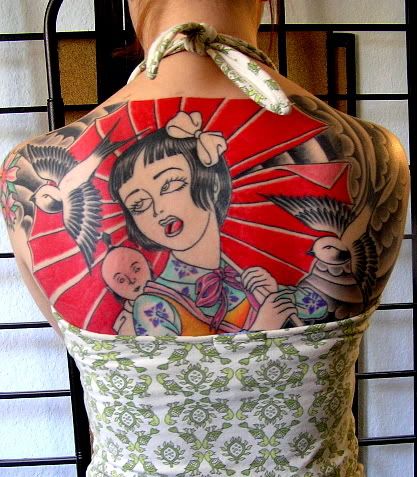
Japanese tattoo art has a lot of names – irezumi and horimono in the Japanese language. Irezumi is the word meant for the basic visible ink covering big parts of the body like the back. Japanese tattoo art has a extremely extensive tradition.
Since the influence of Confucianism and Buddhism over the Japanese culture, tattoo art has a damaging connotation for the majority of the Japanese population. In the eyes of an typical Japanese a ink is considered a mark of a yakuza – a member of the Japanese mafia – and a macho emblem of members of the lesser classes.
The Early History of Japanese Tattoo Art
Archaeologists believe that the initial settlers of Japan, the Ainu citizens, used facial tattoos. Chinese papers tell concerning the Wa inhabitants – the Chinese name meant for their Japanese neighbours – and the individuals lifestyle of diving into water for fish and shells and decorating the total skin with tattoos. These reports are in the region of 1700 years old.
For the top developed Chinese culture, tattooing was a barbaric undertaking. As soon as Buddhism was brought from China to Japan and with it the solid influence of the Chinese culture, tattooing got harmful connotations. Criminals were marked with tattoos to punish and identify them within society.
Tattoos in the Edo Period
In the Edo period – 1603-1868 – Japanese tattoo drawings became a part of ukiyo-e – the suspended world culture. Prostitutes – yujos – of the pleasure quarters used tattoos to improve the individuals prettiness for customers. Skin tattoos were furthermore used by labourers and firemen.
From 1720 on, the tattooing of criminals became an legitimate punishment and replaced taking away of the nose and the ears. The criminal received a ring ink around the arm in support of every offence or else a character ink on his temple. Tattooing criminals was continued until 1870, at what time it was abolished by the new Meiji government of the Japanese Emperor.
This visible punishment produced a further genre of outcasts which had no place taking part in society and nowhere to go. A lot of these outlaws were ronin – master less samurai warriors. They had no alternatives than organizing gangs. These men created the start of the yakuza – the controlled criminals inside Japan inside the twentieth century.
Japanese Tattoo Prints
In 1827 the ukiyo-e artist Kuniyoshi Utagawa published the original 6 emblems of the 108 Heroes of the Suikoden. The Suikoden were something like ancient Robin Hoods – honourable bandits. The story is based on a classic Chinese novel – Shui-Hi-Chuan, which dates from the 13th and 14th century. The novel was initially translated into Japanese in 1757 by Okajima Kanzanion.
By the turn of the 18th to the 19th century the story was available with illustrations by Katsushika Hokusai. The novel of the 108 honourable bandits was extremely accepted in the sphere of Japan and created a kind of Suikoden trend amongst Japanese towns inhabitants.
Kuniyoshi’s Suikoden ukiyo-e emblems bare the heroes in colourful, detailed body tattoos. Japanese ink prints and tattoo drawings in general subsequently became stylish. Tattoos were considered iki – cool – however were restricted to the poorer classes.
The richness and fantasy of the Japanese tattoo print emblems revealed by Kuniyoshi are used by a few ink artists up to this moment.
The Meiji Restoration until Postwar Japan
Within its strive to adopt Western civilizations, the Imperial Meiji government outlawed tattooing as something thought about a barbaric relict of the past. The funny thing was that the Japanese irezumi artists right away got brand new customers – the sailors from the foreign ships anchoring inside Japanese harbours. Hence Japanese ink designs was spread to the West.
In the course of the first half of the twentieth century, horimono remained a forbidden art form until 1948, as soon as the prevention was officially lifted. A few say that this step had become needed to sanction the demand by soldiers of the American occupation forces for horimono and irezumi.
Tattoo Art in Modern Japan
A number of younger individuals may well think about tattooing being cool, the majority of the Japanese population still considers it while something connected to the gangland of mafia gangsters and a rough low caste tradition at the finest.
Younger folks who consider tattoos as iki – a marginal amongst Japanese youth – tend to use partial tattoos inside Western style on the persons upper arms, someplace it is not directly visible.
Showing posts with label Japanese Tattoo. Show all posts
Japanese Sleeves Tattoo
Japanese Sleeve Tattoos come in different forms and designs depending on ones personality and what he wants to be represented by. Because of the popularity of tattoos, people who want to get one now are more particular in the originality and uniqueness of their designs.
There are hundreds of possible tattoo designs to choose from. But since Japan has been in the tattoo business for a very long time, they have developed designs that people have shown more interest in, nowadays, than any other. Japanese sleeve tattoos is what they are called.
Examples these sleeve tattoos are koi fish tattoos, dragons, samurai and hannya masks. Koi fish designs are very popular because of it represent power and strength and they form an illusion of a swimming fish when tattooed on the arm.
Dragon designs are also very popular, next to koi fish designs, because of the masculinity it creates for men who have them. They are either red or black. This design is also a symbol of power and strength as this mythical creature can breathe out fire and is just ready to kill and take an enemy down when needed.
The samurai is a symbol of heroism and great courage. This is one of the reasons why it has become so popular among all sleeve tattoos.
Hannya masks were used before in some plays in Tokyo. But because of its beauty, it has become a piece of art itself. This is believed to have the power to ward of evil. With its beauty and reputation, hannya masks have become another popular tattoo designs, not only in Japan but all over the world.
There are hundreds of possible tattoo designs to choose from. But since Japan has been in the tattoo business for a very long time, they have developed designs that people have shown more interest in, nowadays, than any other. Japanese sleeve tattoos is what they are called.
Examples these sleeve tattoos are koi fish tattoos, dragons, samurai and hannya masks. Koi fish designs are very popular because of it represent power and strength and they form an illusion of a swimming fish when tattooed on the arm.
Dragon designs are also very popular, next to koi fish designs, because of the masculinity it creates for men who have them. They are either red or black. This design is also a symbol of power and strength as this mythical creature can breathe out fire and is just ready to kill and take an enemy down when needed.
The samurai is a symbol of heroism and great courage. This is one of the reasons why it has become so popular among all sleeve tattoos.
Hannya masks were used before in some plays in Tokyo. But because of its beauty, it has become a piece of art itself. This is believed to have the power to ward of evil. With its beauty and reputation, hannya masks have become another popular tattoo designs, not only in Japan but all over the world.
Onko Chishin – Japanese Tattoo Documentary
In this documentary we follow Dutch tattoo artist Rob Admiraal on his trip to Japan where he goes to have a huge dragon tattoo on his back finished, do some tattooing himself and visit other leading Japanese tattooists.
Onko Chishin (Complete with ENG subs) from rodgezooi on Vimeo.
Admiraal gives us a guided tour of Japanese tattooing and explains how traditional art and modern, Western influences each play their part in what tattoo in Japan has become today. He also talks about his personal tastes and preferences and does not hesitate to go deeper into more theoretical aspects of the art, such as the balance between representation and abstraction, typical for Oriental art.
An intriguing scene in the documentary is that in which Admiraal gets the very last part of his huge tattoo done: the eyes of the dragon, which will “bring it to life”. It is nice to see how this Dutch fellow at the same time acknowledges the importance of this almost magical gesture but also stays clear-headed and never seems to get carried away by all the “Orientalism” in which he is surrounded. I don’t know the guy, but I already like him…
The film was made by Rogier Postma.
Subscribe to:
Posts (Atom)